 Rubicexchange
 routing ranks available swap paths by expected destination token output
Rubicexchange routing compares supported on-chain and cross-chain paths by their expected destination token output. The best-quote result identifies the highest expected output among available routes for the requested swap. Choosing a usable path also requires matching its execution model, costs, timing, and provider conditions to the transaction. Quotes can change before submission, and a returned route doesn’t establish successful delivery on the destination chain.
Updated onSelect a route for delivery to the destination wallet
A swap requiring delivery to the destination wallet needs a compatible execution method and a destination result confirming completion. An expected output estimate can be higher than destinationTokenMinAmount, the quoted minimum after slippage. Compare that minimum with the amount you’re willing to accept.
- Match the quote to the source token, amount, destination token, and selected networks.
- Retain paths whose contract calls, native blockchain transactions, or deposit transfers the application can perform.
- Select a compatible path with an acceptable quoted minimum output, using its expected output, charges, and estimated duration for comparison.
- Before sending funds, pause if execution data no longer meets the agreed output or provider requirements. Requote to reconsider the path, and obtain explicit approval for significant output changes before requesting fresh swap data.
- Require destination success after submission; READY_TO_CLAIM means a manual claim remains outstanding.
Before a swap transaction or deposit is sent, requoting lets the application reconsider the route without initiating the transfer. After submission, the existing transfer’s status governs the response to a delay or failure. A new quote doesn’t reverse that transfer.
Expected output and the path behind it
Expected output estimates how much of the selected destination token a route would deliver under its quoted conditions. Comparisons need the same source amount, destination asset, and network combination. Changing those inputs changes the request the router evaluates. Token addresses and blockchain fields identify the assets more precisely than a symbol alone.
A decentralized exchange, or DEX, handles exchange within a blockchain. Bridging connects different chains, while a multi-hop route can combine exchange and cross-chain movement. The routing response includes providers and a token path, exposing components behind the calculation. Those details describe the proposed path; they don’t show completed operations or funds received by the destination wallet.
What does the best-quote result actually optimize?
The best-quote endpoint returns the available route with the highest expected swap output. The all-routes endpoint exposes alternatives ordered by that same output measure. Neither description makes fastest settlement, a particular privacy mechanism, or the absence of a later claim the ranking objective.
A quote is indicative, and requesting execution data recalculates its output amount. Market movement, changing liquidity, and provider recalculation can alter the comparison. An integration must obtain explicit approval for significant output changes, then request fresh swap data before sending funds. That confirmation concerns revised terms; destination status determines whether a submitted cross-chain swap completes.
Provider filters change the routes under consideration
Provider selection settings affect the candidate routes, so a best-quote result applies to the calculation requested by the application.
The providerTags option distinguishes deposit, non-deposit, private, and non-private provider selections. nativeBlacklist excludes provider calculations, while preferredProvider specifies a preferred provider for calculation.
showDangerousRoutes controls whether routes with high slippage or price impact appear in the response. Enabling it allows those routes into the comparison; it doesn’t lower their slippage or price impact.
Execution requirements differ across contract, native, and deposit routes
Contract-based execution, native blockchain transactions, and provider deposits impose different requirements on the application selecting a route. The API returns the relevant execution instructions. It doesn’t automatically broadcast transactions or perform deposit transfers, so an application must support the selected model before offering it as executable.
EVM, short for Ethereum Virtual Machine, contract-based routes can require token approval before the swap transaction. Other EVM routes use deposits. Non-EVM support includes native transactions for TON, TRON, Solana, and Sui, alongside manual deposit-based execution. A route’s blockchain alone doesn’t establish which model applies. Its returned instructions determine the required transaction or transfer.
Deposit-based providers introduce provider-specific identity requirements. ChangeNOW, SimpleSwap, Changelly, Exolix, and Quickex can request KYC when their risk systems flag a transaction. KYC means Know Your Customer. Starting an exchange through Rubic doesn’t require KYC, yet selecting one of these providers makes its AML and KYC policies relevant. AML means Anti-Money Laundering. This condition belongs in provider selection before funds enter that route.
Preparing execution data, authorizing a token allowance, and submitting a transfer establish different states. None alone confirms destination delivery.
Gas and provider charges beside the output estimate
Route costs can include network gas, protocol charges, provider charges, and percentage-based fees, which the API represents separately from its output estimate. A zero protocol charge doesn’t establish a zero-cost transfer. Other fee components may remain. A charge payable in the source network’s native token needs its own balance consideration.
The response distinguishes native-token fee amounts from percentage fees and identifies the token associated with each relevant component. Expected destination output and a separately payable network charge describe different quantities. Treating them as interchangeable can distort the comparison. A destination-token dollar estimate also isn’t the token amount itself. Route selection needs consistent units and a clear view of which charges the returned calculation includes.
Estimated duration and incomplete cross-chain transfers
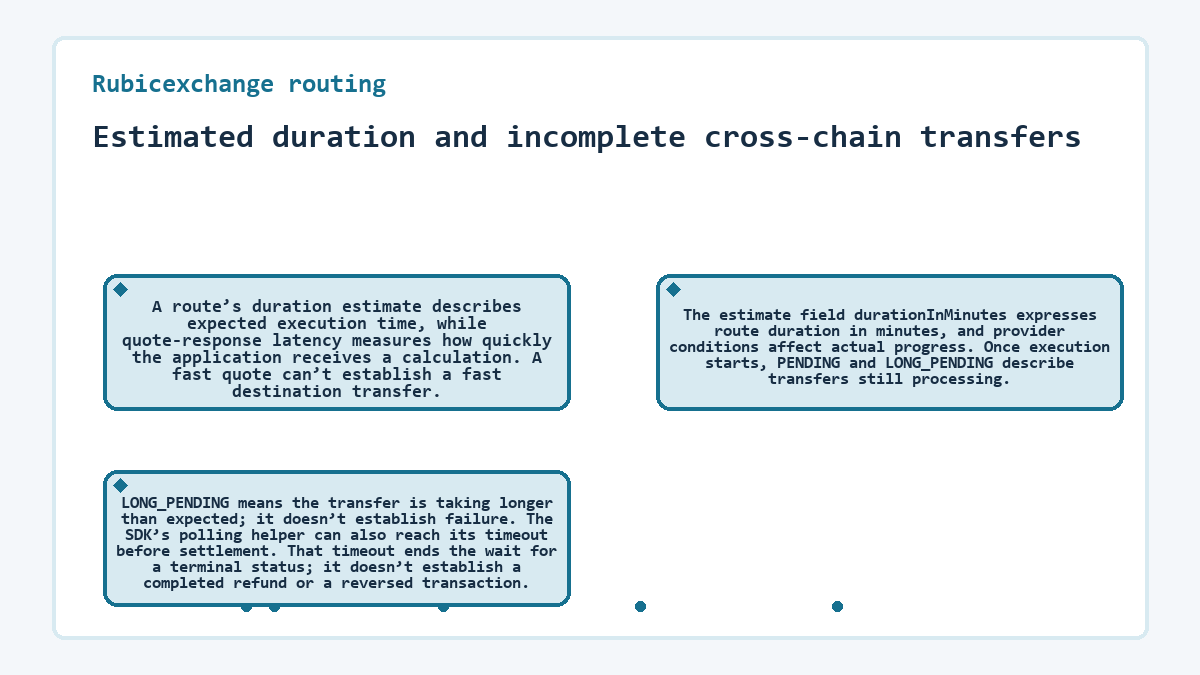
A route’s duration estimate describes expected execution time, while quote-response latency measures how quickly the application receives a calculation. A fast quote can’t establish a fast destination transfer. The estimate field durationInMinutes expresses route duration in minutes, and provider conditions affect actual progress. Once execution starts, PENDING and LONG_PENDING describe transfers still processing. LONG_PENDING means the transfer is taking longer than expected; it doesn’t establish failure. The SDK’s polling helper can also reach its timeout before settlement. That timeout ends the wait for a terminal status; it doesn’t establish a completed refund or a reversed transaction.
Intent providers alongside DEX and bridge paths
Intent-based routes use solvers to fulfill a requested outcome, adding a different execution mechanism to the paths an aggregator compares. Solvers can source liquidity and coordinate operations across services. DEX routes draw on exchange liquidity, and bridge routes provide cross-chain movement. These functions can coexist within a broader execution path.
Provider category alone doesn’t determine the highest-output choice. The requested amount and available liquidity affect the calculation, and solver-based execution introduces its own dependencies. Some intent designs can reduce slippage or exposure to maximal extractable value, known as MEV. The protection depends on the selected protocol’s execution mechanism. Aggregating intent providers doesn’t extend those properties to every DEX or bridge path.
Privacy requirements narrow the acceptable provider set
A privacy requirement adds provider technology and supported assets to the route decision, beyond the expected output used for ordinary ranking. Rubic’s Private Mode beta brings together Railgun, Zama, Houdini Swap, Privacy Cash, Hinkal Protocol, and ClearSwap. Their mechanisms differ, including decentralized approaches and routing through centralized exchanges.
The beta comparison describes differences in fees, estimated time, and required user interactions. Some providers permit direct swaps; others require preparation such as shielding tokens or signing a message. Some providers complete transactions in minutes, while others may take up to an hour. Network and asset coverage also vary. A private-provider label therefore doesn’t establish a uniform privacy guarantee, execution time, or preparation requirement across all available paths.
Monitoring can remove a compromised provider
Provider monitoring can change route availability when Rubic disables an integrated service affected by a critical issue. Monitoring covers provider and blockchain status, stuck transactions, refunds, and operational signals. Rubic describes pausing compromised providers in its contracts and switching them off for integrators, allowing available alternatives to serve subsequent route calculations.
That response concerns the availability of provider paths. It doesn’t establish that a transfer already sent through the affected service has been recovered. Contract audits, multisignature administration, and operational controls also address different risks from quote ranking. A favorable output estimate says nothing about whether every external dependency will continue operating during the swap.
Destination status defines the completion boundary
A submitted cross-chain route needs destination status to distinguish completed delivery from a pending transfer or an outstanding claim. SUCCESS indicates the swap completed, and its destination transaction hash can identify the receiving transaction. READY_TO_CLAIM has a different meaning: an Arbitrum Bridge route requires a manual on-chain claim on the destination network.
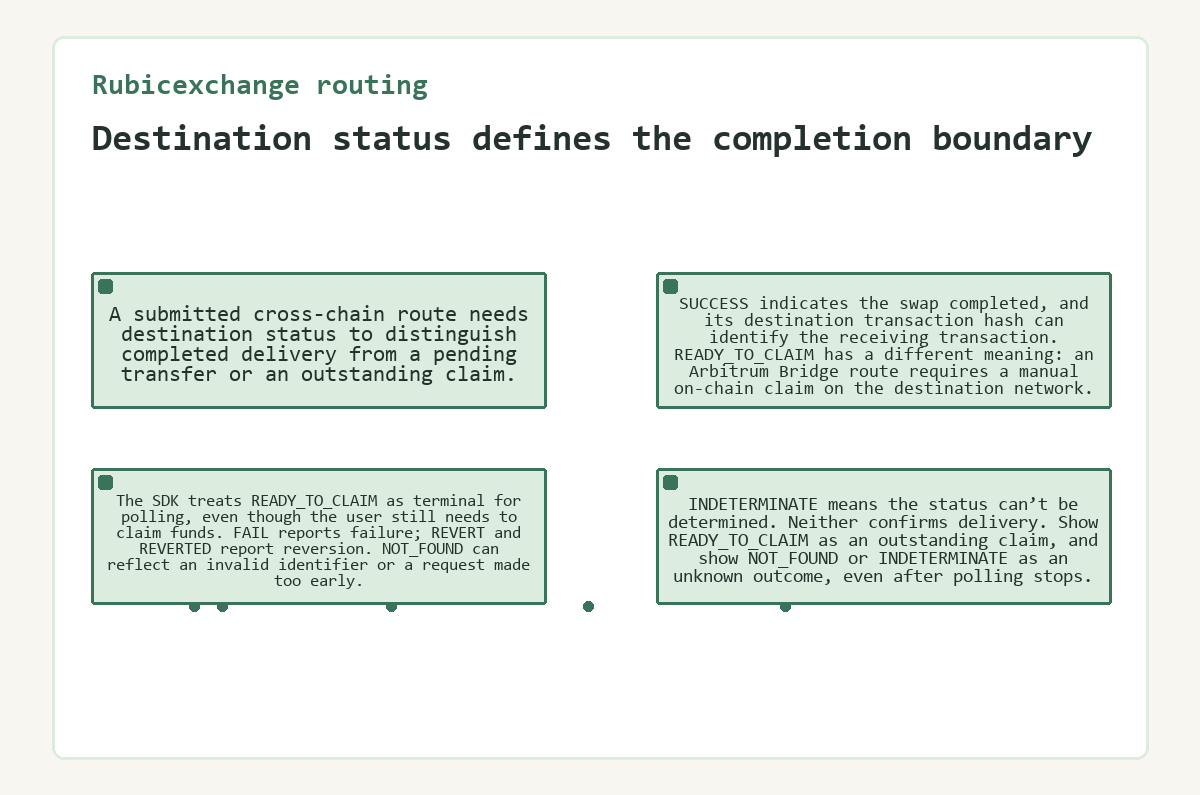
The SDK treats READY_TO_CLAIM as terminal for polling, even though the user still needs to claim funds. FAIL reports failure; REVERT and REVERTED report reversion. NOT_FOUND can reflect an invalid identifier or a request made too early. INDETERMINATE means the status can’t be determined. Neither confirms delivery. Show READY_TO_CLAIM as an outstanding claim, and show NOT_FOUND or INDETERMINATE as an unknown outcome, even after polling stops.
Questions and answers about Rubicexchange routing
-
Can a receiver-only non-EVM wallet accept a routed swap without a second login?
- A non-EVM wallet used only as the receiver can be specified by its destination address without a second wallet login. This applies to receiving assets on a route supporting that network and token. It doesn’t authorize spending from the receiving wallet or establish support for sending assets from it. The source side still follows the transaction or deposit requirements of the selected route.
-
Why does decentralized route tracking require a source transaction hash as well as a trade ID?
- Decentralized-provider status requests require both the trade ID from the swap response and the source transaction hash. These identify the prepared trade and its submitted source-chain transaction. Deposit-based providers use the trade ID without requiring that hash in the status request. The API’s requirements follow the provider model, so having an identifier from quotation alone doesn’t satisfy every route’s tracking requirements.
-
How is refund data requested for a Celer route that can’t complete?
- The Celer refund utility returns execution data when a Celer cross-chain transfer can’t complete and requires a refund on the source or destination network. Its request requires fromBlockchain and sourceTransactionHash. Receiving that data doesn’t submit or complete the refund.
-
What does WAITING_FOR_TRUSTLINE mean for a routed transfer?
- WAITING_FOR_TRUSTLINE means a routed transfer is waiting for a required trustline on the XRP Ledger or Stellar network. WAITING_FOR_REFUND_TRUSTLINE means a trustline is needed before a refund can be issued. Both are intermediate states, distinct from SUCCESS. They identify the prerequisite holding up progress, without establishing that the transfer has failed.
-
Does a GoPlus token indicator establish the security of the entire route?
- The GoPlus indicator describes the selected token’s security classification, not every dependency in the route. Rubic’s token selector distinguishes trust-list membership, no identified concerns, and token code with low-risk or high-risk concerns. They don’t establish that the selected bridge, solver, deposit provider, or cross-chain execution will complete successfully.